
KAST Card Review 2026: A Stablecoin-Native Card I Actually Use Daily
By the MyCardCrypto team · Updated 8 October 2026 · Fees checked on 8 October 2026
I’ve used a virtual KAST card on the free Standard tier since spring 2026, mostly via Apple Pay in the UAE and Cyprus. Re-checked 8 October 2026: 1.5% USD cashback holds; the points token is off.
Best for: stablecoin holders who pay in USD, online or via Apple Pay.
Not for: heavy ATM users, non-USD spenders, anyone wary of Terms treating deposits as sold to KAST.
My rating: 7.5/10 — real cashback, weaker custody terms, no token. This is not financial advice; fees and availability change — check the issuer before applying.
Reader perk: sign up via our link (or enter code LBY9BQVJ) for 10% off your first paid membership.
Is KAST the Right Card for You?
Match your spending pattern to a row. The numbers behind each answer are in the fee sections below.
| Your situation | Best card |
|---|---|
| You hold USDC or USDT and want to spend it globally with little friction | KAST |
| You spend mostly in USD (online subscriptions, US merchants) | KAST |
| You want a free card with cashback paid in dollars | KAST |
| You spend mostly in non-USD currencies and hate FX fees | Wirex One (FX listed as free) |
| You want self-custody from day one | Avici, Bleap or Wirex One |
| You withdraw cash from ATMs often | A traditional bank card |
| You want tiered cashback and will stake an exchange token | Crypto.com card |
KAST Card Fees, Limits & Quick Numbers
Fees checked on 8 October 2026 against the help-centre fee article (last updated 1 September 2026) and the Terms.
| Spec | Value |
|---|---|
| Annual fee (Standard) | $0 |
| USD cashback | 1.5% on the first $2,000/month (max $30) |
| Points on card spend | None on Standard (paid tiers only; not a token) |
| Reserve reward | 8% on Standard until 1 Jul 2027 (two help articles still say 6%) |
| FX fee (non-USD spend) | 0.5%–1.75% |
| FX fee (USD spend) | 0% |
| Stablecoin top-up | 0% (1:1 to USD) |
| Non-stablecoin deposit | 2–7%, varies by token, shown before you confirm |
| ATM fee | $3 + 2% + operator fee (+ FX fee on non-USD) |
| ATM limits | $250 per withdrawal incl. fees; 3 or $750 per rolling 24 h |
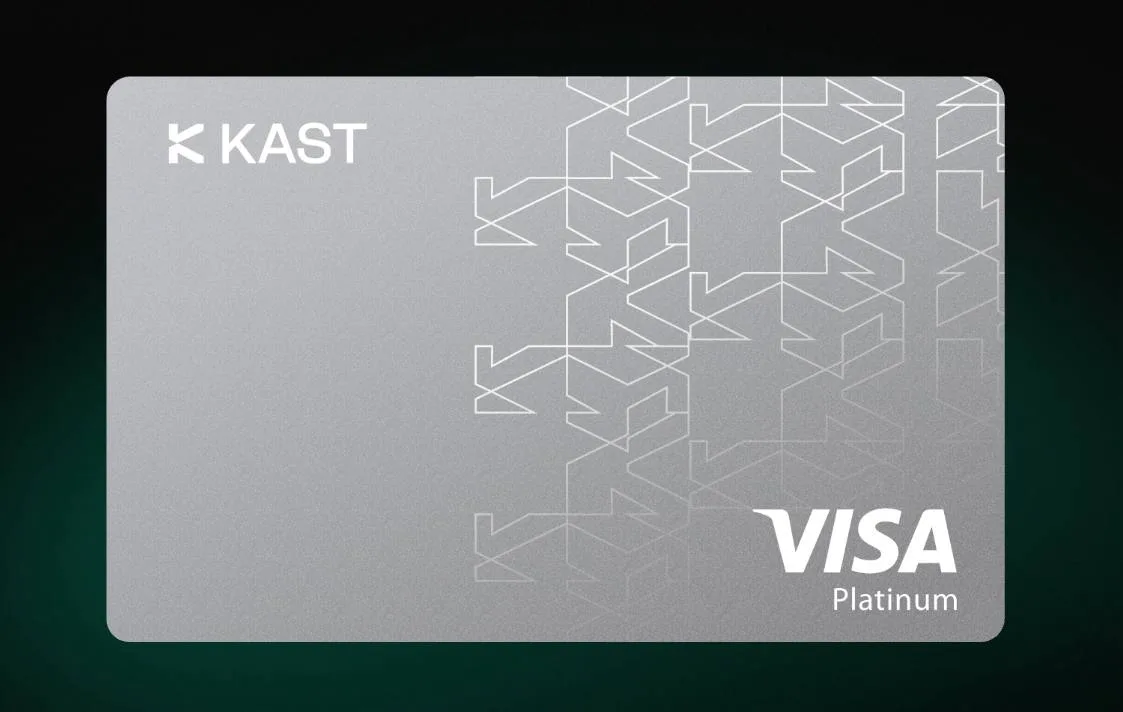
| Card type | Visa Platinum (Standard) |
| Physical / Virtual | 2 included; physical = $40 delivery; $2 virtual issuance in some regions |
| Apple Pay / Google Pay | Yes (Apple Pay depends on your registered country) |
| Custody model | Custodial by default (Terms: deposits are sold to KAST); optional Self-Custody Mode since Sep 2026 |
| Supported regions | 170+ countries; no public list, check the sign-up dropdown |
| Inactivity fee | $1/month after 12 months without activity |
What Changed Since Our May 2026 Review
I wrote this review in May 2026, a couple of months into using the card. On 8 October 2026 we re-read the fee article, the legal pages and the newsroom. In date order:
- 9 March 2026: an $80 million Series A, co-led by QED Investors and Left Lane Capital (our May text wrongly placed it in May).
- 11 April: memberships replaced the old card tiers, and Standard stopped earning Points on card spend (our May text said so only in passing).
- 29 April: new Rewards Terms took effect; their current text (last modified 7 October) lets the company stop Points accrual with 14 days’ notice. Points already credited are kept, though fraud can trigger a clawback, and there is no “Stop Misuse” clause.
- 5 May: USD cashback launched officially at 1.5%, 2% and 3% by tier, with a 14-day lock before you can redeem it.
- 2–3 July: users got emails about turning Points into tokenized equity (reported by CryptoBriefing and KuCoin News), and the CEO wrote on X about an equity-linked instrument; we could not open the original post.
- 7 and 13 July: after a public row over the Terms, the version in force from 7 July still treats deposits as “sold to KAST”, adds a right to redeem the unspent balance and caps liability at $500 under Seychelles law. On 13 July a new US cardholder agreement said the opposite about custody.
- 4 August: the Points page announced, “We are no longer planning a standard token launch for points”. Points now redeem only toward a membership, and a new structure is targeted for Q4 2026.
- 20 August: Reserve launched at 6–12% on USD balances. By October its page showed 8%, 10% and 12% by tier until 1 July 2027.
- 14 September: Self-Custody Mode, an optional switch that holds your USD balance as USDC in a Solana wallet dedicated to you.
My Experience: A Couple of Months In
I added this card mainly to have a stablecoin-native option sitting next to my Wirex. Wirex is my multi-currency travel card; KAST became my “spend my USDC stack” card. Same regions, the UAE and Cyprus, and the same pattern: online payments and Apple Pay everywhere.
Mine is a virtual K Card on the Standard tier, and I’ve paid for everything from ride-hailing to my Claude.ai subscription with it, by tap-to-pay and at online checkouts. Many card reviews are written after a $50 top-up and a few screenshots. This one isn’t.
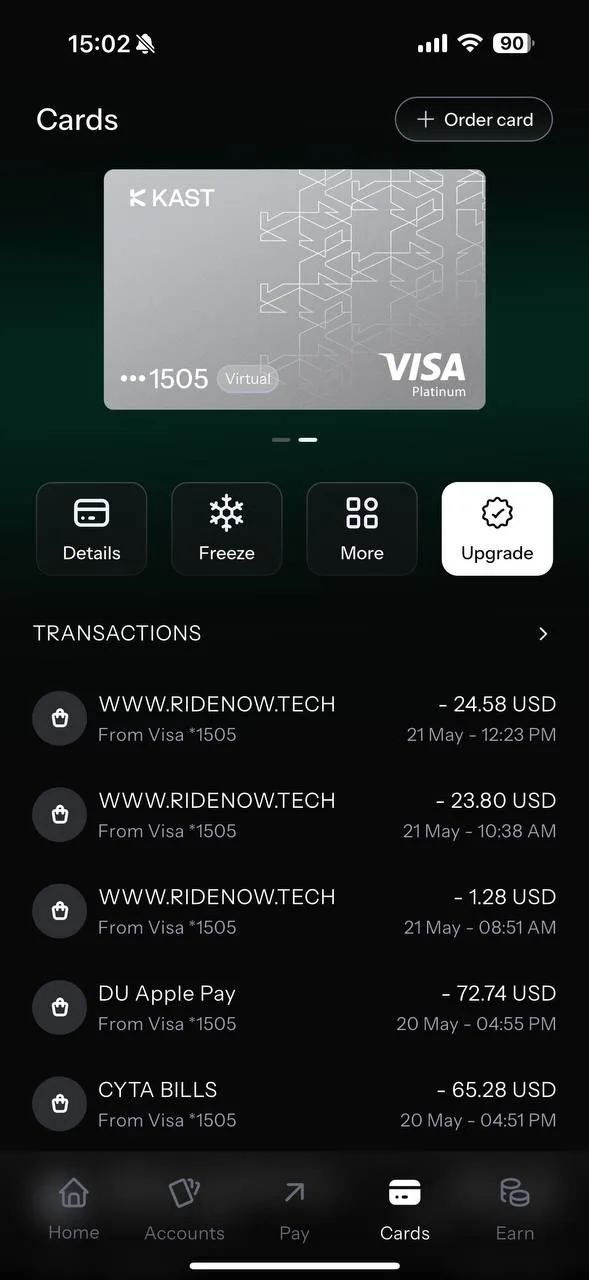
What’s worked, plainly:
- Stablecoin-to-spend is genuinely frictionless. You load USDC, the card draws from a USD balance, you tap to pay. No off-ramp, no “sell crypto, wait for bank transfer, then spend”. It’s the closest thing to spending stablecoins like a normal bank card that I’ve used.
- Apple Pay just works. I added the virtual card to my wallet, and tap-to-pay has been flawless across both countries, with no re-authentication nonsense.
- The app is clean and fast. Transactions show up instantly, and the freeze toggle is genuinely instant. The whole thing feels more modern than most crypto card apps, Wirex included.
- It’s USD-denominated, which is the point. My balance and my cashback are in dollars, and USD spending (subscriptions, online services) carries zero FX fee. For a stablecoin holder, that’s exactly the right design.
What annoys me, honestly
In May my answer was: very little, it does what I want. The only real friction was the ATM situation, and since I don’t use this card for cash (that’s what other cards are for), it didn’t bite me. It’s a young product, and young always carries some risk. The changes since May are in the fee and legal pages, covered next.
The Honest Catch: What Other Reviews Get Wrong
What gets skipped or has gone stale, including in our own May version:
1. Rewards: dollar cashback is real, Points no longer lead to a token
There are two reward streams, and only one of them is money.
Stream 1, USD cashback (real money). On Standard you earn 1.5% back in US dollars on the first $2,000 of card spend each month; anything above that earns nothing on this tier. Here’s the notification I got the moment I paid for my Claude subscription:
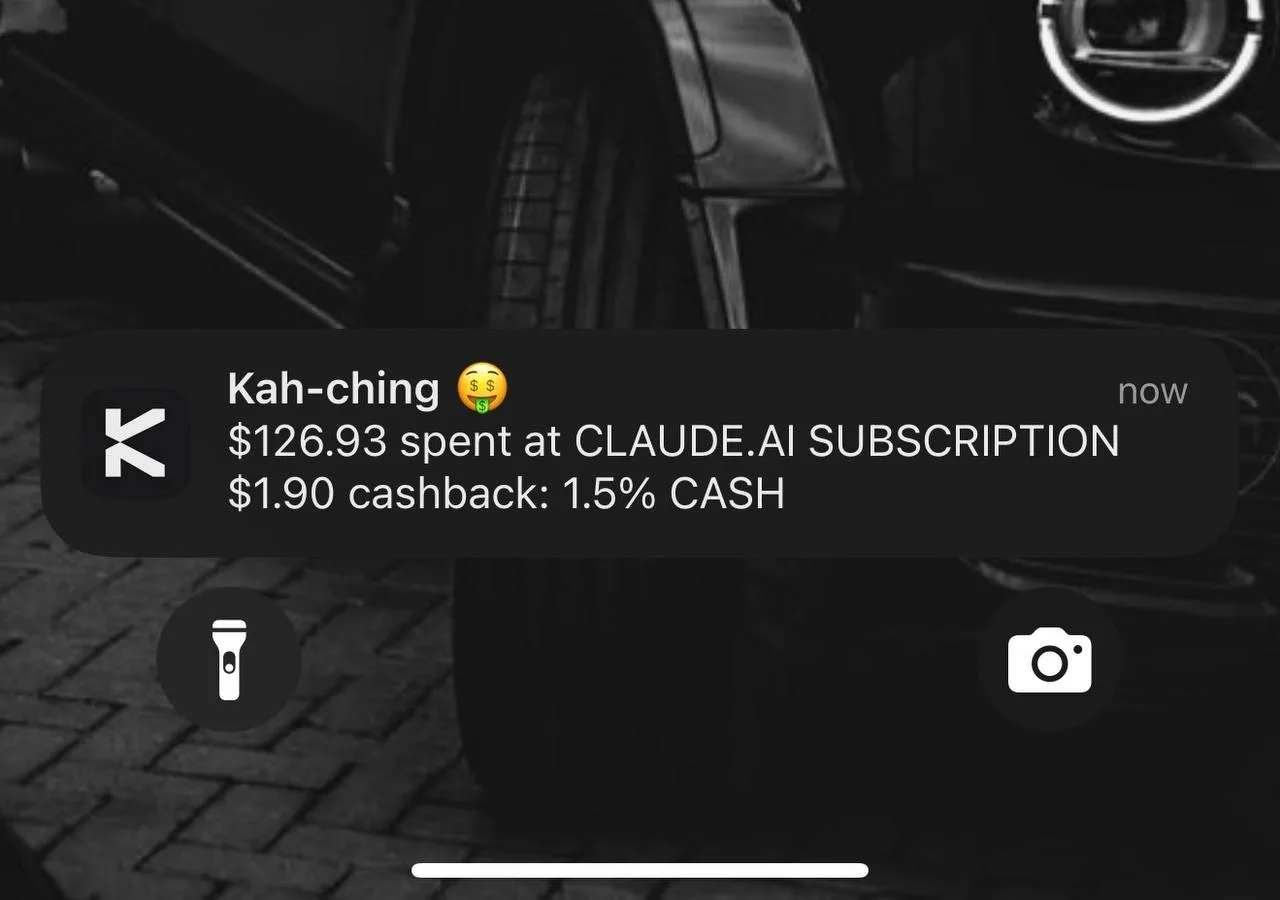
That “$1.90 cashback: 1.5% CASH” on a $126.93 purchase is the real, no-asterisk reward, paid in USD. The catches: it stays locked for 14 days, then you claim it yourself. “Redemption is manual — there is no auto-redemption”, says the help centre. Redeemed cashback pays for your next card purchase; it can’t be withdrawn, and a refund can claw it back.
One more rule worth knowing: if an account is suspended or terminated, unredeemed rewards “will be forfeited without compensation” under the Rewards Terms. Redeem as soon as the lock ends.
Stream 2, Points (no longer a token bet). In May my account showed 1,485 Points, which the app valued at a “notional” $0.08 each. Since 11 April, Standard earns no Points on card spend; only Premium (1%) and Private (2%) do, plus small amounts for staking SOL.
The old airdrop page that promised “1 point = 1 future token” now returns a 404. Instead of a token, the company is exploring a participation structure for meaningful balances that may vary by country, and some users “may receive an alternative redemption or fixed-value cash payment option”.
For now, the only published use for points is a membership: 25,000 for a Premium year, 250,000 for Private. Run my balance through that and 1,485 points cover about 6% of a Premium year. If a $1,000 Premium year costs 25,000 points, each point redeemed that way is worth $0.04, half the old notional figure.
The Points page adds that points are “not cash, currency, property, securities, investments, debt, equity, tokens, or financial instruments”, and that the reference rate “does not create any right to payment”.
A note on $MOVE
In January 2026 Standard still paid 4% back in $MOVE tokens through a Movement Labs partnership. That campaign has ended. I’d earned a decent stack while it ran (around 7,000 $MOVE, which I sold on Bybit). If an older review promises “4% in $MOVE on top of everything”, it’s out of date, and a good example of why these rewards need an asterisk.
2. There’s an FX fee on non-USD spend
The fee article lists 0.5%–1.75% on non-USD transactions; the exact rate “may depend on your country of residence, the country where the transaction takes place”. USD spend is 0%, and small non-USD purchases under $25 add $0.10 each.
Spend mostly in USD and you’ll rarely notice it; pay in euros every day and you will.
3. ATM withdrawals are expensive and capped
If you’re thinking of KAST as a cash card, don’t. A withdrawal costs $3 plus 2% of the amount, plus the FX fee if the cash isn’t dollars, plus whatever the ATM operator charges. The limits article sets a “$250 maximum per withdrawal, including fees”, with up to 3 withdrawals or $750 in a rolling 24-hour period.
Quick math: a $200 withdrawal costs $3 + $4 = $7 before the operator’s cut, 3.5% just to reach your own money. Because the fee sits inside the $250 cap, the most cash a single withdrawal can deliver is about $242 (our calculation). It’s a spending card, not a cash card.
4. Funding with non-stablecoins costs 2–7%
USDT, USDC, PYUSD and RLUSD convert 1:1 to your USD balance with 0% spread. Deposit SOL, ETH or BTC and it’s auto-converted first. The fee article only says the fee “varies by token and is shown before confirmation”; a separate help article gives both “2–5%” and “2% to 7%” in the same text.
On a $1,500 SOL deposit, that’s $30 to $105 gone before your first purchase. The lesson: fund with stablecoins. Convert to USDC first, then load.
5. Custodial on paper, with an optional exit
By default you don’t hold the keys. The Terms in force since 7 July 2026 say: “Virtual Assets transferred by users into KAST are sold to KAST”. A custodian then holds them on the company’s behalf, “not for the users”.
You keep “an affirmative right to redeem or withdraw the unspent balance”, but liability is capped at $500. The contracting entity is registered in Anjouan, Comoros, and Seychelles law governs disputes. The Terms name Tazapay and BitGo among the providers behind payments and custody, and they add: “Your account is not covered by insurance against losses”.
The US cardholder agreement of 13 July says the reverse: the company “will not, in any circumstance, be holding custody of your Collateral”. Third National is the card issuer in both the US and the non-US agreement. Until the documents agree, we read the Terms as the worst case.
That version followed a five-day public argument on X between the CEOs of ether.fi and KAST over how deposits are treated (The Defiant). ChainCatcher reported that the update added the redemption right but kept the sale structure. Since 14 September there is an exit of sorts, the optional Self-Custody Mode described under Beyond the Card.
It’s also young: founded in July 2024, with the $80 million Series A in March 2026 and 1.4 million users claimed on its membership page. App stores are kinder than Trustpilot (2.5 from 220 reviews): 3.97 from 268 ratings on the US App Store and 3.72 from 3,096 on Google Play (8 October 2026). Keep only what you spend on it, not your savings.
Real Fees and Limits
The full Standard schedule from the fee article and the Terms, checked on 8 October 2026.
| Fee | Amount |
|---|---|
| Annual fee (Standard) | $0 |
| Included cards | 2 (virtual or physical) |
| Extra virtual card | $2 each; in some regions also the first two |
| Physical card delivery | $40 |
| Stablecoin top-up | 0% |
| Non-stablecoin deposit | 2–7%, varies by token |
| ACH deposit | $2 |
| Fedwire deposit | $15 |
| SWIFT deposit | $30 |
| SEPA deposit (EUR) | 0.5% |
| FX fee (non-USD) | 0.5%–1.75% |
| Small non-USD purchase (under $25) | $0.10 |
| ATM withdrawal | $3 + 2% + operator (+ FX on non-USD) |
| Declined transaction (insufficient balance) | $0.50 |
| Inactivity (12 months+) | $1/month |
Spending limits: “There are no daily or monthly caps on spending”, per the limits article. Security checks, merchant limits and compliance reviews can still stop a single payment, and the $2,000 monthly cap on Standard limits cashback, not purchases.
Stablecoin withdrawal network fees: Solana ($1 + 0.1%), Arbitrum ($0.20 + 0.1%), Ethereum ($6 + 0.1%) and Tron ($5 + 0.1%), with a $5 minimum withdrawal. Solana is the cheapest route.
Two documents disagree: a help article on unexpected charges mentions a USD 0.01 fee on very small non-USD payments, and the March 2025 non-US cardholder agreement still lists FX “up to 2%” and USD 0.2 per small payment. The $1 inactivity fee comes from the Terms, which also allow deactivating accounts idle for six months.
Cashback Reality: What I Actually Earned
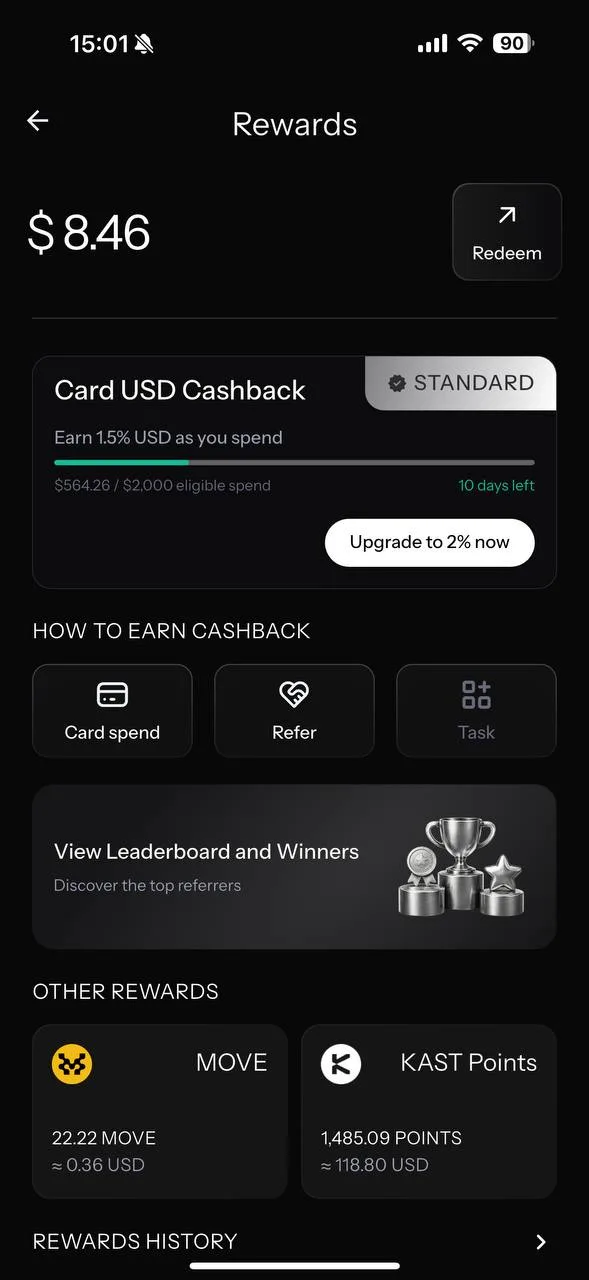
Real numbers from my account, not marketing math. Over roughly my first two months on the free Standard tier (the May screenshot above):
- $8.46 in USD cashback. Real, spendable, at 1.5%. This is the floor, paid in actual dollars.
- 1,485 Points. Under the August rules they’re only good toward a membership, and they cover about 6% of a Premium year. Treat them as zero.
How I cash out: I redeem the USD cashback in the app. When the $MOVE program was still running, I withdrew those tokens straight to Bybit and sold them there, which is how I turned that part of the rewards into spendable cash. With $MOVE gone, the only cash-like reward is the USD cashback, and it can only be spent by card.
The effective rate for a Standard user spending in USD is 1.5%, capped at $30 a month. On non-USD spend, the fee article itself shows an “illustrative net effect” of up to 1% for Standard once FX is deducted. At the 1.75% end of the FX range you are 0.25% down on every euro purchase.
Wirex One now pays USD cashback too, so the edge over Wirex is the rate, not the currency.
One to watch: the Rewards Terms (last modified 7 October 2026) now describe an “AI Card”, a dedicated virtual card. It would earn 10% on the first $1,000 a month at AI merchants on a KAST whitelist, then 5% up to $10,000 and 3% up to $50,000, with no Points and no stacking with membership cashback. The terms call it a promotion “offered for a limited period”; we found no help-centre article about it on 8 October and could not check whether it is live in the app.
Card Format: Virtual-First, Apple Pay, Metal on Paid Tiers
On Standard you get 2 cards included, virtual or physical, issued as Visa Platinum. I run mine entirely virtual and have never ordered the physical card, simply because I don’t need it: for online payments and Apple Pay, plastic is redundant. The option is there, though. A physical card uses your 2-card allowance plus a $40 delivery fee.
Extra virtual cards cost $2 each; in some regions, so do the two included ones.
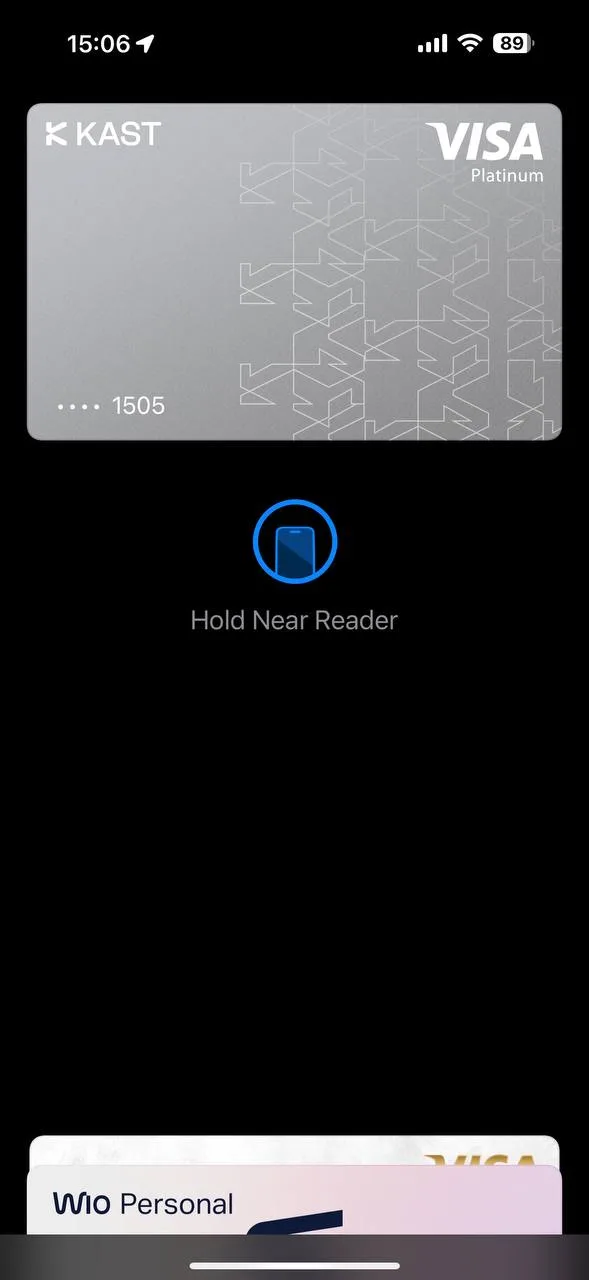
The virtual card drops straight into Apple Wallet (or Google Pay), and from there it’s tap-to-pay anywhere contactless is accepted. This is how I use it almost all the time: phone out, tap, done. It works like a normal bank card at the terminal, and the fee article lists 0% for Apple Pay and Google Pay.
Want a metal card? That’s where the membership tiers come in:
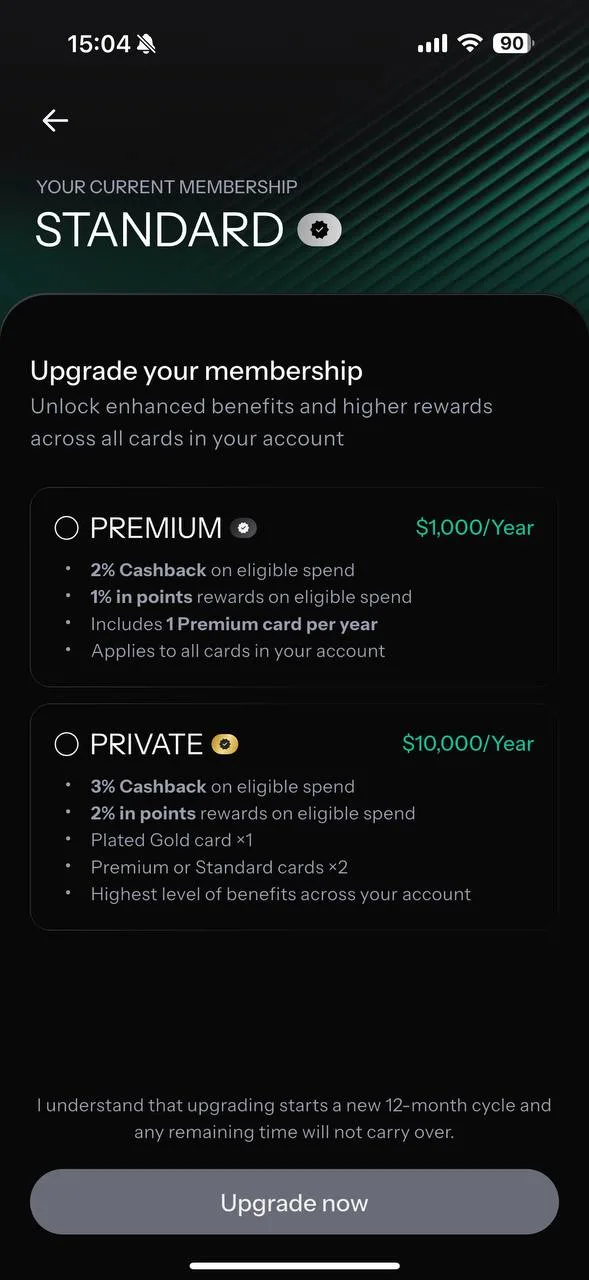
- Standard (free): virtual or physical, 1.5% cashback on up to $2,000 of monthly spend, Visa Platinum, no Points on card spend.
- Premium ($1,000/year): 2% cashback on the first $10,000/month (max $200/month), 1% in Points, Visa Infinite, metal card.
- Private ($10,000/year): 3% cashback on the first $40,000/month (max $1,200/month), 2% in Points, gold-plated card.
There are other designs too (the Solana and Bitcoin cards and the Pudgy Penguins “Pengu” card): same economics, different looks. Lounge access on the Visa Infinite tiers is discounted through Visa Airport Companion, not free. One catch on upgrading: the app warns that it “starts a new 12-month cycle and any remaining time will not carry over”. Don’t upgrade mid-cycle expecting a pro-rated deal.
Is a paid tier worth it? For a typical Standard user, no. Standard’s only Points source now is SOL staking (referral rewards pay cash): 0.25 points per SOL every ~2 days in the fee article, 0.125 in the staking article. By our math, Premium’s extra cashback covers its fee only above roughly $5,700 of card spend a month, before counting Points. On Reserve alone, the help centre’s own table puts the Premium break-even at about $50,000 parked.
Unless you spend at that level and want the metal card, Standard is the right call. I’m on Standard and have no plans to change.
Beyond the Card: Accounts, Transfers, Reserve and Self-Custody
None of this is the reason to get the card, but it’s why the product feels deeper than a standalone card.
USD account with real bank details. The global accounts page offers a US account number and an EU IBAN “from anywhere”, so you can receive ACH and SEPA transfers and hold dollars. For freelancers paid in USD, this is genuinely useful.
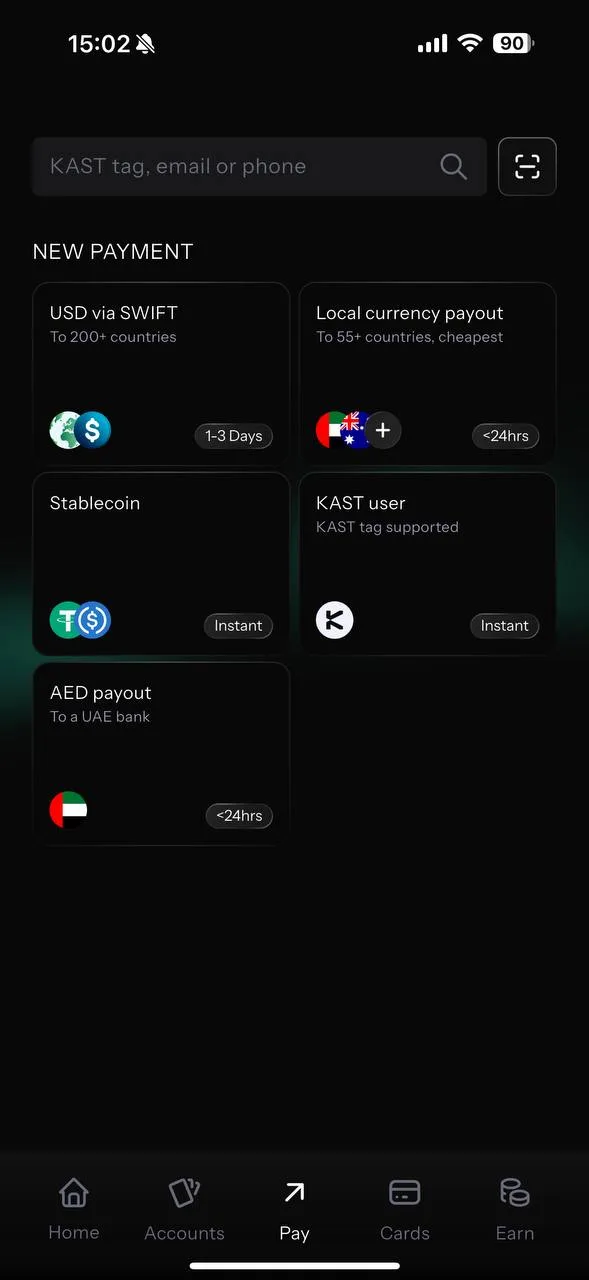
Global transfers. Outgoing USD costs $1 by ACH or $15 by wire, plus 0.08% where applicable, or $30 by SWIFT ($35 on some routes), local-currency payouts cover what the homepage calls 30+ currencies, and stablecoin sends are instant. Transfers to other users by tag are free and instant, up to $10,000 and 5 transfers a day.
Reserve. Launched on 20 August 2026, Reserve pays a daily reward on dollars you set aside: 8% on Standard, 10% on Premium (first $50,000) and 12% on Private (first $200,000) until 1 July 2027, per the Reserve page on 8 October. It’s “Rewards, not interest”, funded “as a subsidy and customer incentive, from its own revenues and corporate balance sheet”.
The help centre isn’t consistent. The rates article ends the boost on 30 June 2027 or at $100 million of total Reserve deposits. Yet its own FAQ and the caps article still quote 6% for Standard and 9% for Premium, and the caps article ends the boost on 31 December 2026. Both agree that “Reserve funds are not insured and are not risk-free”. Treat 8% as a promotion, not a savings rate.
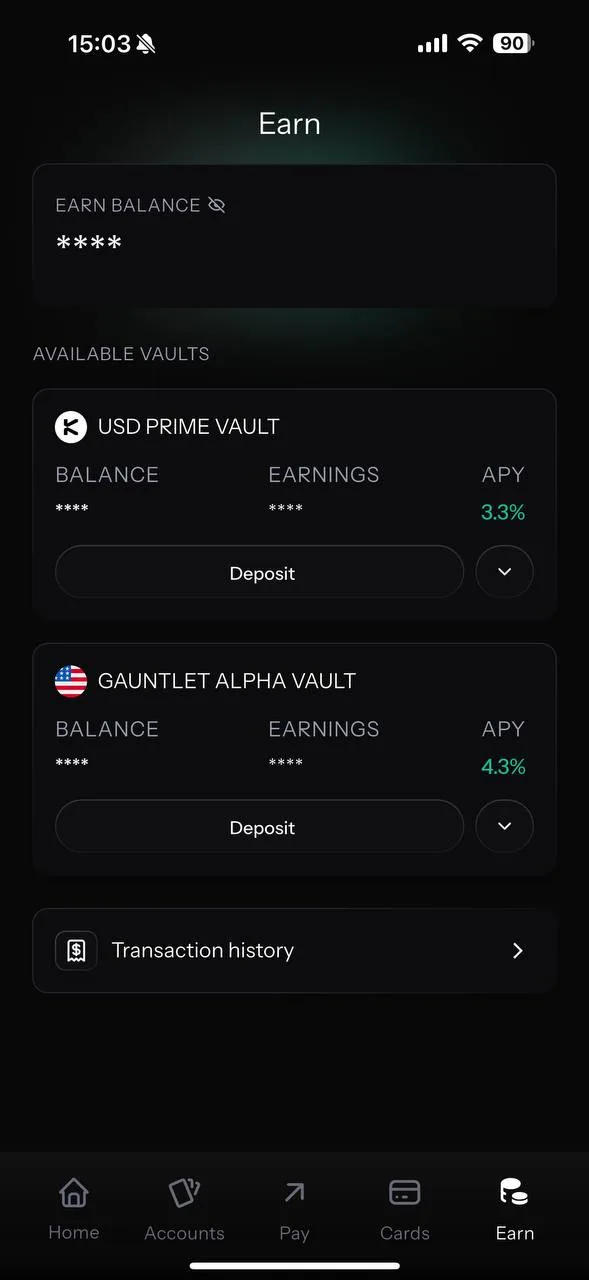
Earn vaults. Rates are variable: on 8 October 2026 the Earn page showed 7% for the Gauntlet Alpha Vault and 3.3% for the USD Prime Vault. The page warns: “This is not a bank deposit”. Yields come from onchain strategies with smart contract and liquidity risks.
Self-Custody Mode. Since 14 September you can switch your USD balance into USDC held in a Privy wallet on Solana dedicated to you, while the card keeps working. Gas for the required transfers is covered, and you can toggle up to 3 times a day. Two limits: key export is “coming soon”, and “The Reserve account cannot be used while Self-Custody Mode is active”.
✅ Pros
- Free Standard tier: no annual fee, 2 cards included.
- 1.5% cashback paid in US dollars, not in a volatile token.
- 0% FX on USD spend and 0% stablecoin top-up.
- Frictionless stablecoin spending: load USDC, tap to pay, no off-ramp.
- Clean, fast app with instant transactions and an instant freeze toggle.
- 170+ countries claimed, including the US, where Wirex One’s card isn’t offered.
- Reserve at 8% on Standard, a promotion until 1 July 2027.
- Optional Self-Custody Mode since September 2026.
- No spending cap beyond your own balance.
❌ Cons
- Cashback stops at $2,000 of monthly spend on Standard.
- FX fee of 0.5%–1.75% on non-USD spend.
- Expensive, tightly capped ATM withdrawals.
- A 2–7% fee when you fund with non-stablecoins.
- Points pivot: no token, no card-spend Points on Standard, a new structure only targeted for Q4 2026.
- Deposits count as a sale to the company, whose liability is capped at $500.
- Documents contradict each other on Reserve rates, conversion fees and custody.
- Trustpilot score of 2.5 from 220 reviews, 61% of them one-star (8 October 2026).
- Young company (founded July 2024) whose reward programs keep changing.
Where KAST Stands Among Crypto Cards
Here’s how it compares with the two cards I use alongside it. Our three-way comparison goes deeper.
KAST vs Wirex (now Wirex One)
I’ve used both side by side, so this is the comparison I know best. One caveat: Wirex is moving customers to a new app, Wirex One, which launched publicly on 16 September 2026 (in the EEA the old app shut on 30 September). The Wirex numbers below come from its help centre on 8 October 2026, not from my old account; our Wirex review covers the card I’ve used for years.
Where KAST wins
- Cashback on the free tier: 1.5% vs 0.5% on Wirex One’s Base level, both now paid in USD. Wirex’s higher levels need a $500–$50,000 portfolio with 1–10% of it in its WPAY token.
- A physical card on the free tier ($40 delivery), while Wirex One’s Base card is virtual-only.
- Coverage: KAST serves the US and claims 170+ countries (no public list); Wirex One’s card list has 73 countries, with no US, Canada or Singapore (our count).
- Reserve at 8% on the free tier until 1 July 2027 (both apps now have USD and EUR accounts).
- A more modern app than the old Wirex app I used.
Where Wirex wins
- FX: Wirex One lists the foreign transaction fee as “Free”, against 0.5%–1.75% here on non-USD spend.
- Self-custody by default: keys are managed through Privy and can be exported to MetaMask or Phantom, and Wirex says it “has no technical ability to access, move, freeze, or reverse” your digital assets.
- Track record: Wirex has been around since 2014; this company was founded in July 2024.
- Around 70 supported assets, against a single USD balance here (other coins are converted on deposit).
- Possibly cheaper cash on its physical cards (Premium level and up): Wirex One’s fee article lists no ATM fee (a June version said 2% above a free allowance). The free Base card is virtual and can’t withdraw cash.
Trustpilot is no tiebreaker: KAST scores 2.5 from 220 reviews, Wirex 2.3 from 17,658 (both checked 8 October 2026).
Use KAST if: you hold stablecoins, spend in USD, want 1.5% dollar cashback on a free tier and value broad country coverage.
Use Wirex One if: you spend in many local currencies, want self-custody by default, or want a company with a decade-long track record.
KAST vs Avici
Avici is self-custodial: you hold the keys, and it’s a secured credit card on Solana. Your USDC sits in a loan escrow contract that, per Avici’s docs, “neither Third National or Avici or Visa controls”. Same issuer, fundamentally different model; my Avici review has the details.
Where Avici wins: self-custody by design (nobody can freeze what they don’t hold), a 0% FX markup (Visa may add a 0.4–1% cross-border fee on non-USD), and Visa Signature perks for $30 in the first year, then $20 a year. Where KAST wins: real cashback (Avici pays none on card spend), simpler UX, wider coverage (Avici isn’t offered in the EU or UK) and the bundled accounts.
Use KAST if you want rewards and convenience and are comfortable with custody. Use Avici if self-custody is non-negotiable and you don’t care about cashback.
What about RedotPay, Crypto.com and other cards?
If you want another custodial option, RedotPay is the obvious one. It charges no monthly fee but $10 for a virtual card and $100 for a physical one. It adds about 1% to every card payment plus 1.2% on non-USD spend, pays cashback only on its paid Pro plan and doesn’t onboard US citizens (help centre, 8 October 2026). In August 2026 Binance-affiliated companies sued its founders; RedotPay says it is defending the case (Cointelegraph).
Exchange cards are a different deal: Crypto.com’s higher cashback tiers need a CRO stake or a subscription, and Binance’s card isn’t offered in the US, EU or UK. To spend stablecoins with dollar cashback, this card is the cleaner answer.
Frequently Asked Questions
How does the KAST card work?
You verify your ID, deposit stablecoins (USDT, USDC, PYUSD or RLUSD), and they become a USD balance at 1:1. The card spends that balance wherever Visa is accepted, online or by tapping your phone through Apple Pay or Google Pay. Cashback lands in dollars, while other coins are converted first for a 2–7% fee.
Is KAST a bank, and is it safe?
No. The Terms say: “The Company is not a bank, it is a technology company”. Your balance isn’t insured, and liability is capped at $500. As of 8 October 2026 we found no reports of a hack or mass loss of funds, but late-September Trustpilot reviews describe frozen accounts.
Is the KAST card a credit card or a debit card?
Technically a credit card. The help centre says each card “is a credit card issued through a banking partner, with a credit line secured by your deposited balance”. The issuer is Third National. In practice it spends like a debit card: your spending “is limited by your available credit line”, and your own deposit backs that line.
What is the difference between cashback and Points?
Cashback is dollars: 1.5% on Standard for the first $2,000 of monthly spend, locked for 14 days and then redeemable toward card purchases. Points are earned on card spend only on Premium (1%) and Private (2%), can’t be cashed out, and for now count only toward a membership. Count the cashback as money and the Points as nothing.
Will there be a points token or $MOVE rewards again?
Not as planned. Since 4 August 2026 the Points page has ruled out a standard token launch. Holders of large balances may get an economic participation structure, targeted for Q4 2026; smaller balances may get alternative redemption, and some users a fixed-value cash payment. The $MOVE campaign, which paid 4% back as recently as January 2026, has ended.
Does the card charge FX or ATM fees?
FX is 0% on USD transactions and 0.5%–1.75% on other currencies, depending on where you live and spend; small non-USD purchases under $25 add $0.10. ATM withdrawals cost $3 plus 2% plus any operator fee, with at most $250 per withdrawal including fees, and 3 withdrawals or $750 per 24 hours.
Which countries does KAST support, and does Apple Pay work?
The company claims 170+ countries but publishes no list: “If you don’t see your country in the dropdown menu, we haven’t launched there yet”. Apple Pay depends on the country of residence you registered, not where you are; the help-centre list includes the US, much of Europe, the UAE and Latin America. It has worked for me in the UAE and Cyprus.
Is the free Standard tier enough?
For a typical spender, yes. Premium pays for itself on cashback alone only at around $5,700 of card spend a month, by our math, and that ignores Points. The paid tiers suit very high spenders who want a metal card, discounted lounges and Points. I use Standard and see no reason to upgrade.
Final Verdict
My May verdict came after a couple of months of running it next to my Wirex. The October re-check changes the score, not the core job.
KAST is the best stablecoin-native spending card I’ve used. Load USDC, tap to pay anywhere, earn real dollars back: it nails the core job better than anything else in its category.
It’s further from perfect than it was in May. Non-USD FX still makes it a weaker travel card than Wirex, ATMs are poor value, and cashback stops at $2,000 of monthly spend. The points token is off, and the July Terms treat your deposit as a sale to the company, with liability capped at $500. These programs shift under your feet.
- “I hold stablecoins and spend in USD / online”: this card does that job well.
- “I travel and spend in many local currencies”: Wirex One’s free FX probably wins.
- “I want self-custody”: Avici, Bleap or Wirex One; Self-Custody Mode here is a half-step until key export arrives.
- “I withdraw cash constantly”: none of these; use a bank card for ATMs.
My rating
7.5/10
Down from 8/10 in May. Still above Wirex One’s 6/10 in my book for triple the free-tier cashback (1.5% vs 0.5%), US availability and a more modern app. Marked down for deposit terms that read as a sale with a $500 liability cap, the cancelled points token, a weak Trustpilot score and documents that contradict each other.
If you spend stablecoins and want cashback in real dollars, it remains one of the strongest options right now, as long as you keep only spending money on it.
Use code LBY9BQVJ for 10% off your first paid membership ($100 off Premium, $1,000 off Private).
This review combines my experience as a Standard user since spring 2026 with a document re-check on 8 October 2026; verify current terms at kast.xyz before signing up. Cashback and crypto conversions can have tax consequences (see our guide to crypto cards). This article contains affiliate links: a sign-up via my link may earn me a referral reward at no cost to you.